Even though it was against “my” Cleveland Browns, I have an indelible and great memory of being informed that Willis Crenshaw of the then St. Louis Cardinals, scored on a 78 yard play (it was a pass from Charlie Johnson) in a past game.
It turned out to be 1965, a year the/my Browns went to the title game, not 1966, which I researched first.
The play occurred in Crenshaw and the St. Louis Cardinals’ rout win at Cleveland, early in the ’65 season.
I believe I was walking around outside and eventually wound up at the door of good man, Kenny Weiner. At that point, I was told by Mr. Weiner (alas we perhaps, incorrectly, called other parents, by their first names, thus he was “Kenny”), that an update, sans studio in those days, informed regarding the Crenshaw play.
Years later, Willis Crenshaw scored the first touchdown at Denver’s Mile High Stadium in 1970. Additionally, Charlie Johnson was the Denver quarterback when the team’s fortunes began to turn for the better as they nearly made the playoffs for the first time in 1973.
Yesterday, it was really nice to watch the 1965 film, “Hysteria,” starring the fine actor Robert Webber, one of the men around the jury table, in the classic film, “Twelve Angry Men.”
As I tend to do, here are some notes linking the film and sports, in this case Southern California (USC) and for that matter, Los Angeles professional football.
A character in “Hysteria,” is Marcus Allan, (played by Peter Woodthorpe–alas a great sport’s name, think “Smoky” Joe Wood and the immortal, Jim Thorpe), spelled one letter different, than how famed U.S.C. and Los Angeles Raiders’ great, Marcus Allen spells his name.
Another actor in the film is John Arnott, not all that different, than the highly under rated, great USC and Los Angeles Rams’ all purpose running back, Jon Arnett.
All in all, and all cited provided a nicer day than without.
Robert Webber is pictured, seated and with his arm raised for the correct “not guilty” vote, closest to and just right of “jury foreman,” Martin Balsam (standing).
“Can” you go around the table and name the other ten fabulous actors? If you “can” or want to try, let me know.
The 1962 World Series came down to the bottom of the 9th inning in the decisive 7th game, with the defending and 19 time World Series champion, New York Yankees leading the S.F. Giants (1-0).
However, the Giants had runners on second and third, with the imposing and eventually great, Willie McCovey at bat.
Ralph Terry, who had surrendered the World Series winning home run to Bill Mazeroski 2 years earlier, won this one, when McCovey’s line drive went “straight to (second baseman) Bobby Richardson,” who snared it for the Yankees’ 20th title.
It is noteworthy that in Richardson’s first at bat in game 3, he flied out, to right fielder, Willie McCovey.
George Kell, a true rarity as he was outstanding both as a player and broadcaster, noted how Richardson was playing McCovey, upon Willie’s first at bat in #3.
His call of the series’ climactic play and one of the most dramatic of any World Series, stated that McCovey hit a liner, “but straight to (Bobby) Richardson.”
(Another) “yesterday,” begins this post, as “yesterday” marked the 75th anniversary of Franklin Delano Roosevelt’s death.
I know there is a world crisis in our midst (Mr. Roosevelt certainly had to “deal” with crisis, they were, but perhaps are (nothing) “new’), however, it seems the anniversary and the man himself, get far too little attention.
Thus, I take this time to note Mr. Roosevelt’s greatness along with his failings and dare say, he was a great unifying, popular leader, master politician–a rich man, who cared about those less fortunate.
All in all pretty darn good, as was his fateful speech of December 8, 1941 which began with the word “Yesterday.”
All four of The Beatles shown performing “Yesterday” in Munich, Germany in 1966 via the link below were alive, as bombs dropped on their home country of England. Think about it, years gone by, Germany, England, Easter, Passover and hopefully better “yesterdays,” on which to look back, in the tomorrows ahead.
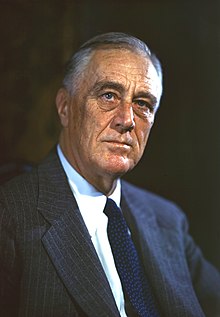
Above a photograph of Mr. Roosevelt by Leon Perskie taken in 1944.
Today, another great episode of the television show, “What’s My Line?”
The episode with mystery guest, Tony Randall aired on August 16, 1964, a day in which 3 baseball doubleheaders were played, including a rare one at Dodger Stadium, contested between the L.A.Dodgers and St. Louis Cardinals.
More on that baseball day in a future post.
Panelists on “What’s My Line?” that Sunday night were Dorothy Kilgallen, the brilliant comedian Buddy Hackett, Arlene Francis and Bennett Cerf.
John Charles Daly is the show’s host. Enjoy the episode.
The Pittsburgh Pirates overcame a (2-0) World Series deficit in 1971, taking the crown from the defending champion Baltimore Orioles, a team that had its third straight 100 plus wins season.
In winning the last 5 games, Pirate’s pitchers, who took a back seat in most pre Series talk to the 4 Orioles starting pitchers, who won 20 or more games that season, allowed but 8 runs and 21 hits.
That is less than 2 runs per game and just over 4 hits per game. Steve Blass won 2 of those games, including #7.
The World Series MVP was the great Roberto Clemente and as I viewed him going into the dressing room after the triumph, he is approached by NBC’s Tony Kubek for a post-game interview.
Kubek played on 3 New York Yankees’ title teams (’58, ’61 and ’62), but was denied by another Clemente Pirates’ W.S. winner in 1960.
Certainly a key play in the epic 7th game of that 1960 World Series, was when a ball hit by Bill Virdon with Gino Cimoli on first, (none out, bottom 8, with the Yankees leading 7-4), took an unexpected hop and hit Kubek in the throat.
Instead of 4 outs to go, up 3 runs, the Yankees faced 2 on with none out. Of course the odds were still in their favor and credit the Pirates for scoring 5 runs in that inning, to take a (9-7) lead.
Credit the vaunted Yankees for tying the game, with 2 runs in the top of the 9th.
Next Bill Mazeroski hit a home run leading off the bottom of the 9th to give Pittsburgh their first crown in 35 (Manny Sanguillen, who played on the next two and to this point, last Pirates’ title teams wore #35) years.
Sanguillen was a catcher and unlike so many, I do not forget and always cite catcher Hal Smith, who recently died at age 89, hitting a 3 run home run to cap that extraordinary Pirates’ 8th inning, in what was arguably baseball’s greatest game.
Click below to view Hal Smith’s 3 run home run in game 7 of the 1960 World Series. Mel Allen is the television announcer, while Chuck Thompson working with Jack Quinlan, made an extraordinary radio call of the home run.
I gave an audio tape of that game to Bob Costas at Runyon’s ( The radio program”Costas Coast To Coast” was broadcast from there) in New York City over 30 years ago. In a subsequent conversation, Bob a great broadcaster himself, marveled at Jack Quinlan’s work.
In those better days of rare, if any words from analysts, who now talk, seemingly, after every pitch, Quinlan invoked “Chuck I do not know why you called on me,” after Smith’s home run.
Smith is greeted by #24, Dick Groat and Mr. Clemente (#21). I do not know who that is pictured at the far right.
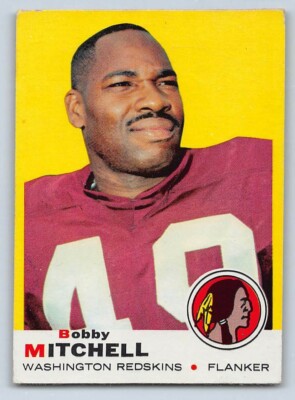
The great player, Bobby Mitchell, who died days back at the age of 84, was so much more than the first black player on the Washington D.C. NFL team. That gives you an idea of all that he accomplished, all the while, maintaining great dignity. No mean feat.
Bobby was indeed the first such player on the team, after his trade from Cleveland, after playing his first four seasons (’58-’61) there, forming an all-time running tandem with the great Jim Brown.
Another great, Lenny Moore marveled that Bobby, as future teammate Charley Taylor also did, was a standout first as a running back and then a receiver.
Oh what an offensive show it was, the great passer Sonny Jurgensen throwing to Bobby, Charley (Taylor) and tight end, Jerry Smith.
In 1967 the trio ranked first, second and fourth in the league, surely unprecedented (for the record, Charley first, Bobby second and Willie Richardson of the Baltimore Colts was third).
Watching Bobby run, with his “on a dime” cutbacks, was to watch a gifted football genius.
He made major contributions as a team executive, as well.
Below is a tremendous piece written by Ray Didinger, about Jerry Smith, just after he died. The bonds of friendship formed among Jurgensen, Taylor, Bobby, defensive back Brig Owens and Jerry, who died after being stricken with AIDS, transcended sports and inspire.
It speaks volumes about all those men, as today, we remember Bobby Mitchell, the first black player in Washington team history, for his on and off the field, superb accomplishments.
THE COURAGE OF JERRY SMITH – Chicago Tribune
In last night’s “Perry Mason” episode on MeTV, titled “The Case of the Borrowed Baby,” I noticed actor Hugh Marlowe, I believe, best known for his role in “All About Eve,” a true movie classic.
While researching Hugh in “Eve” in which his character was married to that of Celeste Holm, I was struck by a picture of the great stage and later film actor, Walter Hampden.
Mr. Hampden, for 27 years the President of the Player’s Club in New York City, played the father of brothers Humphrey Bogart and William Holden in the film version of “Sabrina.”
More research “yielded” that “The Beverly Hillbillies” cohorts Raymond Bailey (“Mr. Drysdale”) and Nancy Kulp (“Jane Hathaway”) each had uncredited parts in “Sabrina.”
Nice to know.

Walter Hampden, for whom the wonderful library at The Player’s Club is named, pictured above.
Often, even before the great player, Al Kaline died days back at the age of 85, I played the great broadcaster Ernie Harwell’s call of a seminal moment in Detroit Tigers’ history.
They clinch the ’72 A.L. East title when Al comes in and grabs Ben Oglivie’s drive to right. Harwell’s superb broadcasting call includes “(it is) fitting that the great veteran, Al Kaline makes (catches) the final out of the ballgame.”
Yes, so appropriate and so deserving, as was the even greater result of Kaline in his first and only World Series, playing great and the Tigers overcoming a (3-1) World Series deficit, to take the 1968 crown. I have posted regarding such in the past and will do so in the future. There is so much to it!
Sure, as with most people, especially “ball fans,” I am partial to “my time” and the players of that time.
In any list I compile, often in “daydreaming reflection,” I include Al Kaline as a true great from that/”my time.”
He could hit, field and certainly throw with the best of them. In looking back, how appropriate (there is that word again), he won the first Roberto Clemente Award. (Both Al and Roberto had superb throwing arms which pales next to their generosity and kindness.)
There were 3,007 hits and 399 home runs and by one day the youngest player to win a batting crown, that in 1955.
The Detroit Tigers have been blessed with some truly great players, certainly Ty Cobb, who won 12 batting crowns, but never was on a World Series winner. Another was Hank Greenberg, who endured anti-Semitism, once hit 58 home runs in a season and played on 2 World Series winners with the Tigers.
Al Kaline is another and I believe the 1968 title, for many reasons was the best in Tigers’ lore and one of the best for any team.
So much happened in the world that year! In Detroit, (riots and a near pennant miss in a great American League race, that word with a different meaning, sadly apropos of the riots) so much the year before.
In game 5/’68 World Series, Al delivered the biggest hit of his great career, a bloop, 2 run single vs game 3 Cards’ pitching star, Joe Hoerner, that gave the Tigers the lead to stay in that game.
The hit transformed a deficit, the last one the Tigers faced in that ’68 “classic,” as they also won games 6 and 7, and their first title in 23 (Willie Horton’s #) years.
Then and now, how “appropriate” Al Kaline seized the moment, the title to me, (not him), more important than his Hall induction (even though he did make it on the first ballot. Then again, Joe DiMaggio did not), the greatest prize in Al’s superb career.
Perhaps there is a better place to which he is headed. Surely we can daydream and reflect, as I do regarding “my time” greats such as Al Kaline.
Click below for a brief previous post about the great Al Kaline.
Thoughts regarding Al Kaline

Al Kaline, pictured above.
Today, a very special episode of “What’s My Line?” that aired in July of 1961 with the great Yogi Berra as the mystery guest.
Enjoy as Yogi talks of a weekend, seems a hot one weather wise, in which Mickey Mantle, Whitey Ford and I guess Joe DeMaestri stayed at Yogi’s home, as Berra’s wife, whom he adored, Carmen, was away. Great stuff!
The panelists were Dorothy Kilgallen, Martin Gabel (about to visit his wife Arlene Francis, a “What’s My Line?” regular panelist, in Europe, where she was working in a movie), Suzy Parker and Bennett Cerf.
John Charles Daly is the show’s host. This is a really enjoyable and informative episode. Enjoy it.
 Andy B Sports